Responding to a Patient Complaint: A Training Checklist for Hospital Teams
Every hospital receives complaints. Some are about waiting times or billing. Others concern clinical care, communication, or outcomes. How a hospital responds in the first hours and days often decides whether a complaint is resolved respectfully or escalates into a consumer case, a medical council complaint, media attention, or a criminal complaint.
Many escalations happen not because the hospital did something seriously wrong, but because the complaint was handled badly: the patient felt ignored, records were incomplete, staff gave inconsistent statements, or communication became defensive.
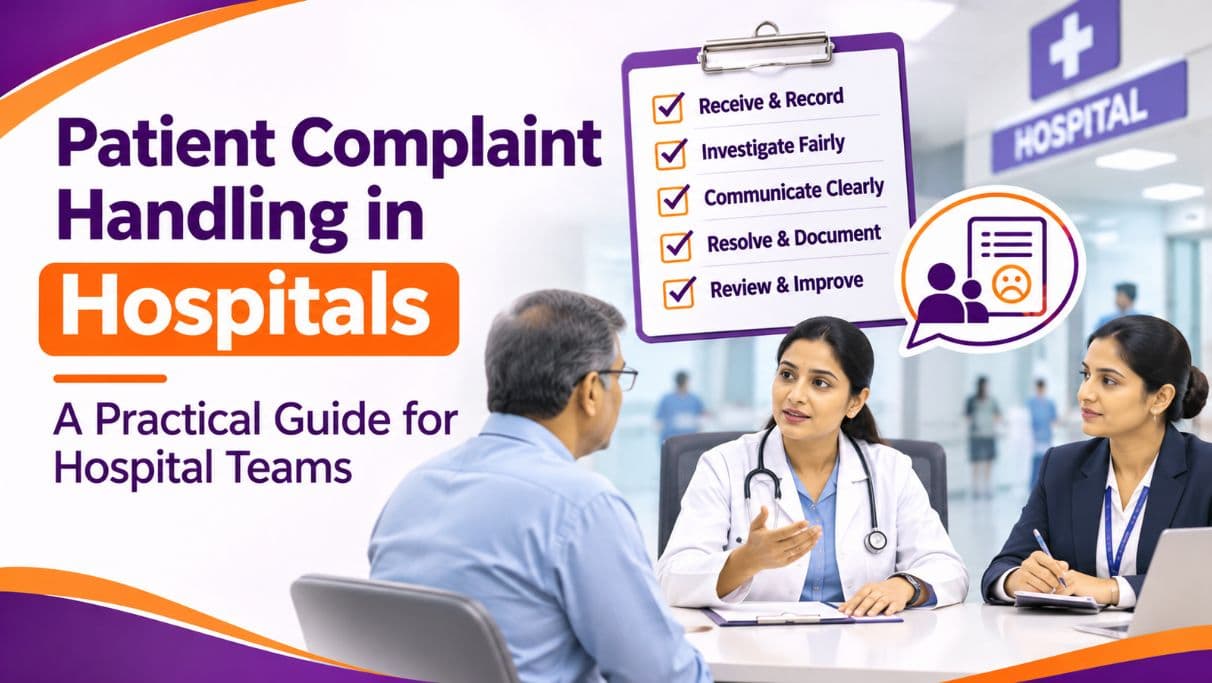
A structured approach to patient complaint handling in hospitals helps teams receive concerns professionally, protect relevant records, communicate appropriately and ensure that complaints reach the right people for review. This checklist helps hospital teams build a consistent complaint-handling process and practise it through training.
Receive and Log Every Complaint
Complaints can arrive through many channels: verbal complaints at the bedside, written letters, emails, online reviews, social media, phone calls, or government grievance portals. A good hospital complaint management system captures all of them rather than allowing complaints to remain informal or untracked.
✅ Checklist
- ✓Designate a person or team responsible for receiving complaints.
- ✓Use a single complaint register or system to log every complaint.
- ✓Record the date, time, complainant, patient details, channel, summary of concern and staff involved, while protecting confidential information.
- ✓Acknowledge receipt promptly, with a reference number and expected timeline.
- ✓Classify the complaint: service, billing, communication, clinical care, staff behaviour or facilities.
- ✓Flag complaints involving serious harm, death, allegations of negligence or legal notices for immediate escalation.
Frontline staff should know that complaints are not to be dismissed, argued with or ignored. Even a simple acknowledgement can reduce frustration. A central register supports hospital complaint management by tracking pending cases, identifying patterns, and monitoring whether responses are completed. Hospitals should also make their patient grievance redressal process easy to find and accessible to patients and families.
Preserve Records
For complaints involving clinical care, preserving records immediately is essential.
- ›Secure the complete medical record: case sheet, nursing notes, investigation reports, consent forms, imaging, prescriptions, and billing.
- ›Make sure electronic records are backed up and access is logged.
- ›Collect CCTV footage if relevant and if retention periods are short, following applicable policies and legal requirements.
- ›Do not alter, add to, or rewrite records after a complaint. Late entries, if genuinely needed, must be clearly marked with the actual date and time and the reason.
- ›Note the names of all staff involved.
Altered or missing records seriously damage a hospital’s ability to explain its actions, even when care was appropriate. Record preservation should be built into the hospital complaint handling process, particularly when a complaint concerns clinical care, serious harm or a possible legal dispute.
Internal Escalation
Complaints should reach the right people at the right time. Hospitals should have a defined escalation matrix so staff know who is responsible for reviewing each type of complaint and when management must be informed.
| Complaint type | Typical escalation |
|---|---|
| Service or facility | Department head, operations manager |
| Billing | Billing head, finance |
| Staff behaviour | Department head, HR |
| Clinical care | Treating consultant, medical superintendent, quality team |
| Serious harm, death, legal notice | Medical director, medico-legal team, legal advisor, management |
| Media or social media | Management and designated communications person |
Define timelines for each level. Senior management should be informed early about serious complaints, not after they escalate. The hospital complaint handling process should clearly specify responsibility, escalation criteria, and how complaint status is tracked. The same process should be understood by staff across departments so complaints are not delayed because ownership is unclear.
Patient Communication
Communication with the patient and family is often the most important part of complaint handling.
Principles
- ✓Listen fully before responding.
- ✓Acknowledge the patient’s experience and feelings.
- ✓Provide factual information that can be shared appropriately.
- ✓Avoid blaming the patient, other staff, or other departments.
- ✓Avoid speculation about causes before review.
- ✓Explain the next steps and timelines.
- ✓Document every significant conversation in the complaint file.
Expressing regret for a patient’s distress is different from admitting liability. Staff should be trained on how to communicate empathetically without making statements that pre-judge a review. Respectful, timely communication can support patient complaint resolution by addressing concerns, clarifying next steps, and avoiding unnecessary misunderstandings. Training should include scenarios demonstrating how patient complaint resolution requires listening, accurate information, timely follow-up and respectful communication.
Who Should Speak?
Designate who communicates with the family in serious cases: usually a senior clinician with a member of administration or patient relations. Multiple staff giving different explanations creates confusion and mistrust.
A designated spokesperson can help maintain a consistent hospital complaint response, ensuring that information shared with patients or families is appropriate, factual, and coordinated. Define who is authorised to provide the hospital complaint response in routine and serious cases.
Qualified Legal Advice
Some complaints require legal input:
- ⚠Legal notices from lawyers.
- ⚠Consumer commission complaints.
- ⚠Complaints to medical councils.
- ⚠Police complaints or FIRs.
- ⚠Complaints involving death or serious harm.
- ⚠Media coverage involving serious allegations.
In these situations, involve the hospital’s legal advisor or medico-legal consultant early. Staff should not respond to legal notices or give written statements to external parties without guidance. Indemnity insurers may also need to be informed within specified timelines, according to the policy terms.
A clear process for medico-legal complaint handling helps staff recognise when a complaint requires specialist review rather than a routine administrative response. Hospital leaders should establish who coordinates medico-legal complaint handling, record preservation, external communication and insurer notification, where applicable.
For related guidance, see Understanding Deficiency in Medical Service under the Consumer Protection Act & Medical Negligence Defense for Doctors in India.
Internal Review
Each significant complaint should lead to a review of what happened and whether systems can be improved.
- ›Collect accounts from staff involved, in writing, where appropriate.
- ›Review records against standard protocols.
- ›Identify contributing factors: communication, staffing, processes, equipment or other system issues.
- ›Decide on actions: training, process changes, policy updates or further review.
- ›Close the loop with the complainant where appropriate.
Reviews should focus on learning and improvement, not just blame. A structured medical complaint management review can help distinguish individual concerns from recurring system issues. Hospitals should use medical complaint management findings to identify trends, improve communication, update procedures and strengthen staff training. This evidence also supports hospital complaint management decisions about priorities and corrective actions.
When a complaint involves a dispute that may benefit from a resolution pathway, hospitals can explore Alternative Dispute Resolution in Healthcare in India: Why It’s Becoming Essential.
A Suggested Response Timeline
Timelines should be defined in hospital policy, but a practical framework might look like this. These are suggested internal operational targets, not universal statutory deadlines.
| Stage | Suggested action |
|---|---|
| Immediately | Acknowledge verbally, ensure patient safety, inform supervisor |
| Same day | Log complaint, secure records for clinical complaints, inform department head |
| Within 24 to 48 hours | Written acknowledgement with reference number; escalate serious cases to management |
| Within agreed period | Complete internal review and respond to complainant |
| After response | Record outcome, actions taken and lessons learned |
For serious incidents or legal notices, faster escalation and legal advice are needed. A clear timeline helps staff deliver a consistent response without promising an outcome before the review is complete.
Handling Complaints on Social Media
Complaints increasingly appear on social media or review sites. Train designated staff to:
- ›Respond calmly and briefly, inviting the person to contact the hospital directly.
- ›Never share patient details, diagnoses or treatment information publicly.
- ›Avoid arguments or defensive replies.
- ›Log the complaint in the internal system and follow the usual process.
- ›Escalate to management if the post is spreading widely or contains allegations of serious harm.
Online complaints should be treated as a potential entry point to the hospital’s complaint process, not as a separate issue that bypasses internal review.
Common Mistakes in Complaint Handling
- ⚠Arguing with the complainant at the first contact.
- ⚠Different staff giving different explanations.
- ⚠Delaying acknowledgement while waiting for a full review.
- ⚠Adding entries to the medical record after a complaint without marking them properly.
- ⚠Responding to legal notices without advice.
- ⚠Treating complaints as personal attacks rather than information.
Avoiding these mistakes is a practical part of patient complaint handling in hospitals. Staff need to understand that the objective is not to dismiss criticism, but to respond respectfully, protect records, investigate concerns, and take appropriate corrective action.
Training and Review
Complaint handling is a skill that can be trained. A practical hospital complaint handling training programme includes:
- ›Role plays of receiving verbal complaints at the bedside or front desk.
- ›Practice writing acknowledgements and responses.
- ›Case discussions using anonymised or fictional complaints.
- ›Clear explanation of the escalation matrix.
- ›Guidance on documentation and record preservation.
- ›Sessions for senior staff on communicating in serious cases.
Training should also be adapted to the responsibilities of each staff group and reinforce patient complaint handling in hospitals as a repeatable, patient-centred process.
| Staff group | Training focus |
|---|---|
| Front desk and patient relations | Receiving, logging, acknowledging, de-escalation |
| Nurses | Bedside complaints, documentation, escalation |
| Resident doctors | Communication, documentation, escalation |
| Consultants | Serious complaint communication, record review |
| Management | Oversight, legal coordination, policy updates |
Effective hospital complaint handling training should include practical exercises and feedback, not just lectures. Staff should practise how to acknowledge concerns, record details, escalate complaints and communicate without becoming defensive. The patient grievance redressal process should be covered during induction and refresher sessions, so staff know how to guide patients and families.
Track complaint trends regularly. Patterns, such as repeated billing complaints or communication issues in one department, show where training or process changes are needed. Review whether the training has improved complaint logging, acknowledgement times, escalation and patient communication.
Frequently Asked Questions
Should we respond to negative online reviews?
A calm, professional response that invites the person to contact the hospital directly can help. Avoid sharing patient information publicly.
How fast should a complaint be acknowledged?
As quickly as possible. Define timelines in your policy and communicate them to the complainant.
Can good complaint handling prevent legal cases?
It cannot prevent all cases, but respectful, transparent handling may reduce avoidable escalation and help patients feel heard. Complaints still need to be investigated objectively, and serious matters should receive appropriate clinical and legal review.
Train Your Team With MedipreneurX
MedipreneurX offers medico-legal education and training for hospitals. A structured programme focused on patient complaint handling in hospitals can help teams practise complaint receipt, communication, documentation, escalation, and internal review using realistic hospital scenarios.
Hospitals can also explore Medico Legal Consultant in India for Doctors & Hospitals for relevant medico-legal support.