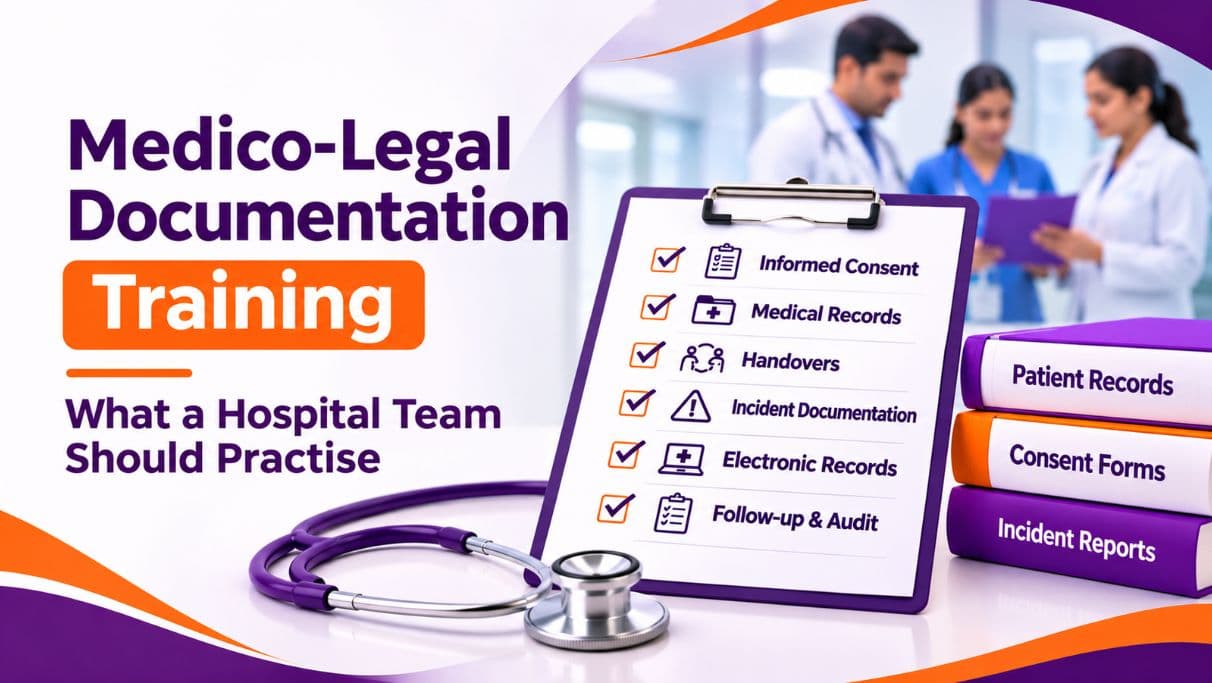
Medico-Legal Documentation Training: What a Hospital Team Should Practise
When a patient complaint reaches a consumer commission or a medical council, the hospital’s medical records often become important evidence. Well-maintained documentation helps show what was done, why it was done, and what consent was obtained. Poorly documented care can leave gaps that are difficult to explain years later, even when the clinical care was appropriate.
Most documentation problems are not caused by carelessness. They come from busy wards, unclear formats, rushed handovers, and staff who were never trained on what good medico-legal documentation looks like. Medico-legal documentation training can address these gaps when it is practical and built around real hospital workflows.
This guide explains what hospital teams should practise during documentation training and how to make it effective in daily clinical practice.
Identify Workflow Gaps First
Effective medical documentation training starts with understanding where documentation breaks down in your hospital. Before designing a programme, review:
- ›A sample of case files from different departments, with patient identifiers protected.
- ›Recent complaints, incidents, or near misses and what the records showed.
- ›Existing forms and templates, and how they are used in practice.
- ›Feedback from nurses, residents, and consultants on documentation challenges.
- ›Audit findings from accreditation or internal quality reviews, if available.
Common gaps include missing time entries, unsigned notes, illegible handwriting, incomplete consent forms, unrecorded verbal orders, missing discharge summaries, and gaps during shift changes. These recurring clinical documentation errors can be converted into practical training scenarios so staff can recognise and correct them.
Consent and Records
Informed Consent
Consent is one of the frequently examined areas in medico-legal disputes. Training should cover:
- ›The difference between general consent and procedure-specific informed consent.
- ›What information should be discussed: nature of the procedure, risks, benefits, alternatives and what happens if the patient declines.
- ›Who should take consent and when.
- ›Consent in special situations: minors, emergencies, patients who lack capacity, and high-risk procedures, according to applicable law and professional guidance.
- ›Documenting the discussion, not just obtaining a signature. Practise informed consent documentation that reflects what was explained and understood.
- ›Language and comprehension: explaining in a language the patient understands.
Medical Records
Medical records documentation training should reinforce consistent, accurate and timely record keeping. Teams should practise:
- ›Legible, dated and timed entries with signature and name.
- ›Recording clinical findings, decisions and reasons.
- ›Documenting advice given, including advice refused by the patient.
- ›Corrections made properly, without overwriting or erasing.
- ›Record retention and access according to applicable rules and professional requirements.
For further reading, refer to Medical Records in India: Legal Requirements Every Doctor Should Know.
Handovers
Shift changes and transfers between departments are high-risk points for missing information. Medico-legal documentation during handovers should be clear, relevant and structured.
| Handover point | What should be documented |
|---|---|
| Nursing shift change | Patient status, pending tasks, medications due, concerns |
| Doctor-to-doctor handover | Diagnosis, plan, pending investigations, escalation criteria |
| Ward to ICU / OT | Reason for transfer, current status, consent status |
| Discharge | Diagnosis, treatment given, medications, follow-up, warning signs |
| Referral to another hospital | Reason, condition at transfer, documents sent |
Structured handover tools help teams communicate consistently. Training should include practising handovers using realistic scenarios, with attention to the information that the receiving team needs to continue care safely.
Incident Documentation
When something goes wrong, such as a fall, medication error, unexpected deterioration or adverse event, documentation becomes critical.
Training should cover:
- ›What to record in the patient file: objective facts, time, actions taken, people informed.
- ›What to report through the hospital’s incident reporting system.
- ›Communication with the patient and family, and documenting that communication.
- ›Avoiding speculation, blame or alterations in the medical record.
- ›Escalation to senior staff and the medico-legal or quality team.
Teams should understand the difference between the clinical record and internal incident reports, and how each is handled. Incident simulations can help staff practise medico-legal documentation that is factual, timely and appropriately recorded.
Use Anonymised Exercises
Lectures alone rarely change behaviour. Practical exercises work better:
Case file review. Participants review anonymised or fictional case files and identify documentation gaps.
Consent role play. One participant explains a procedure while others observe and give feedback.
Rewrite exercise. Participants rewrite poor entries into clear, complete notes.
Incident simulation. Teams document a simulated adverse event.
Handover practice. Structured handovers using example patients.
All examples should be fictional or fully anonymised to protect patient confidentiality.
These exercises should form the practical core of hospital medico-legal training, allowing staff to apply documentation principles to situations they may encounter in their own departments.
Assessment and Follow-Up
Training should be followed by measurement to see whether practice improves.
- ›Pre- and post-training documentation audits on a sample of files.
- ›Short knowledge assessments.
- ›Department-wise feedback on common errors.
- ›Refresher sessions for new joiners and periodic updates.
- ›Updating templates and forms based on what training reveals.
A simple audit checklist can track progress:
| Audit item | Before training | After training |
|---|---|---|
| Entries dated, timed and signed | Audit result | Audit result |
| Procedure-specific consent complete | Audit result | Audit result |
| Discharge summary complete | Audit result | Audit result |
| Handover notes present | Audit result | Audit result |
| Incident documentation complete | Audit result | Audit result |
A medical documentation audit can help identify recurring gaps, while a follow-up review can assess whether the training and updated forms have improved record quality. Use the findings to plan refresher sessions and department-specific support.
Electronic Medical Records: New Strengths, New Risks
Many hospitals now use electronic records, which improve legibility and access but introduce new documentation risks. Training should cover:
Copy-paste notes. Copying previous entries can carry forward outdated or incorrect information.
Templates. Pre-filled templates may record findings that were not actually examined.
Login sharing. Entries made under another person’s login create confusion about authorship.
Audit trails. Electronic systems log edits, so late changes are visible and must be justified.
Downtime procedures. Teams need a clear process for documenting when systems are unavailable and entering information later.
Electronic record scenarios should be included in medical documentation training, particularly where staff work across different departments or use shared templates.
Common Documentation Errors and Better Practice
| Common error | Better practice |
|---|---|
| “Patient stable” with no details | Record vital signs, findings and assessment |
| Entry without time | Date and time every entry |
| Consent form signed but discussion not recorded | Note what was explained and the patient’s questions |
| Verbal order not documented | Record verbal orders and follow the hospital’s countersignature process |
| Advice refused not noted | Document advice given and the patient’s decision |
| Late entry written as if contemporaneous | Mark late entries clearly with actual time and reason |
| Abbreviations unclear | Use standard approved abbreviations only |
Using examples like these in training sessions helps staff recognise their own habits and correct them. A focused medical documentation audit after training can check whether these practices are improving.
Who Should Be Trained?
Documentation is a team responsibility. Training should include:
- ✓Consultants and resident doctors.
- ✓Nursing staff at all levels.
- ✓Front-desk and admission staff who handle forms.
- ✓Medical records department staff.
- ✓Quality and administration teams.
Sessions may need to be tailored to each group’s role. Hospital documentation training should use role-specific scenarios so staff practise the documentation tasks they are responsible for. Broader hospital medico-legal training can also include discussions on legal duties, communication and escalation.
Frequently Asked Questions
How long should a documentation training programme be?
It depends on the team size and needs. Short focused sessions combined with practical exercises and follow-up audits often work better than one long lecture.
Can documentation training reduce litigation?
Good documentation cannot prevent every complaint, but it helps hospitals show what was done and why, which is important when disputes arise. Training should focus on accurate, complete and timely records—not on creating defensive or retrospective documentation.
Should training be repeated?
Yes. Staff turnover, new regulations and changes in templates make periodic refreshers useful.
What should a hospital include in documentation training?
Hospitals should cover consent, medical records, handovers, incident reporting, electronic records, common documentation gaps and practical exercises. The scope should reflect the hospital’s workflow and relevant professional requirements.
Enquire About Documentation Training
MedipreneurX offers medico-legal education for doctors and hospital teams. Medico-legal documentation training can help hospital teams identify documentation gaps, practise consistent recording and strengthen day-to-day workflows. The training scope and format can be discussed according to the hospital’s requirements.
Hospitals interested in broader medico-legal education can also explore Why Doctors Need Medical Law and Ethics Training in Today’s Healthcare System and the Master in Indian Medical Law course.