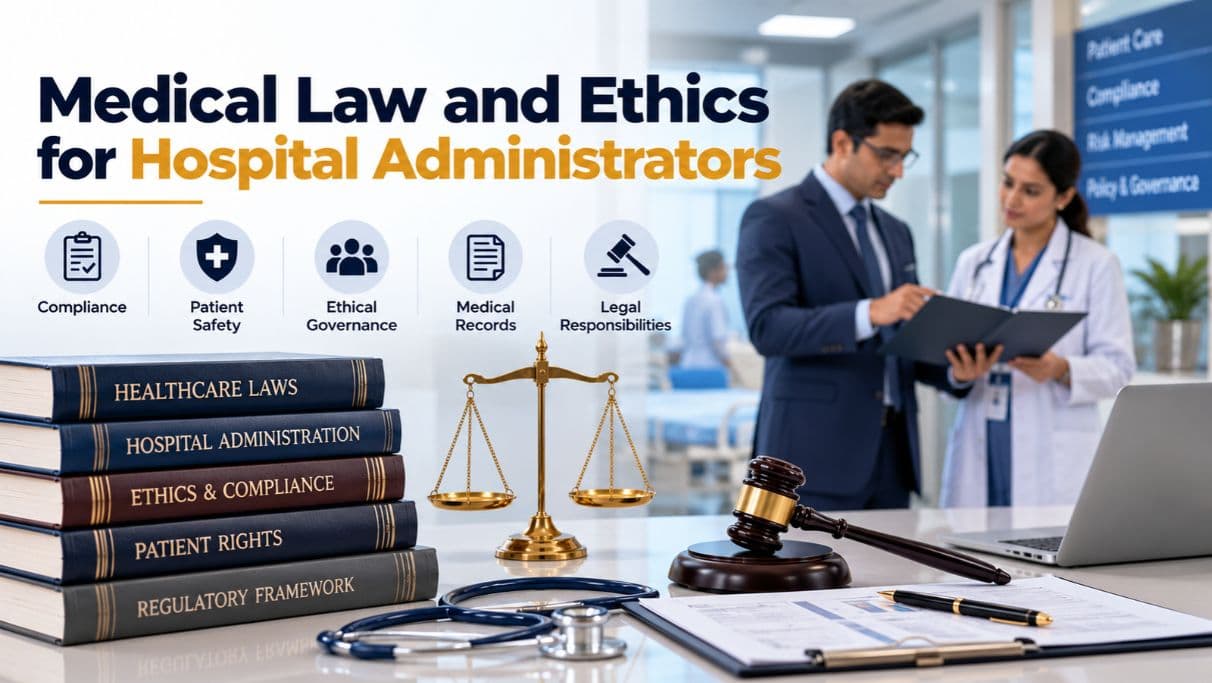
Medical Law and Ethics for Hospital Administrators: Legal Responsibilities & Compliance
The quality of its medical care judges a hospital, but its management systems play an equally important role in patient safety and institutional accountability. When a patient files a complaint, a regulator conducts an inspection, or confidential patient information is exposed, the hospital may need to demonstrate what policies, safeguards, and oversight mechanisms were in place. That is why medical law for hospital administrators is no longer a niche subject reserved for legal departments. It is an essential management competency that supports patient safety, ethical decision-making, and institutional compliance.
This guide explains the principal legal responsibilities, ethical obligations, and practical compliance measures hospital administrators should understand within the Indian healthcare system.
Why Administrators Carry Legal Responsibility
Many administrators assume that liability for a treatment error rests exclusively with the treating doctor. However, hospitals may also face legal responsibility for the acts or omissions of employees acting within the scope of their duties, depending on the circumstances and applicable law. This is commonly discussed under the principle of vicarious liability.
Hospitals may also face claims relating to deficiency in service under the Consumer Protection Act, 2019, where the relevant legal requirements are satisfied. Such claims may involve clinical care, administrative processes, infrastructure, communication or other aspects of the services provided.
For example, inadequate staffing arrangements, malfunctioning equipment, poorly maintained records or failures in established safety procedures may raise questions about institutional management rather than an individual clinical decision alone.
A working knowledge of medical law for hospital administrators helps management identify these risks, assign responsibility, and establish systems to address problems before they escalate into complaints or legal disputes.
The Legal Framework Every Administrator Should Know
Medical law for hospital administrators in India involves several central laws, state-specific rules, professional regulations, and judicial decisions. The precise obligations depend on the hospital’s location, size, services, and legal status.
Important legal frameworks include:
Clinical Establishments (Registration and Regulation) Act, 2010, and applicable state laws: These govern registration and minimum standards where the central Act or the relevant state legislation applies.
Consumer Protection Act, 2019: Provides consumer-law remedies for qualifying complaints involving deficient services and other covered matters.
Bharatiya Nyaya Sanhita, 2023: Contains criminal-law provisions relevant to specified negligent acts and other offences.
Digital Personal Data Protection Act, 2023, and applicable rules: Establish a framework for processing digital personal data, subject to the applicable commencement timeline and requirements.
PCPNDT Act, 1994, MTP Act, 1971, and Transplantation of Human Organs and Tissues Act, 1994: Govern particular medical services and procedures.
Bio-Medical Waste Management Rules, 2016: Set requirements for the management of biomedical waste.
Fire safety, pharmacy, blood bank and radiation-related regulations: Establish additional requirements depending on the facility’s activities and equipment.
Sexual Harassment of Women at Workplace (Prevention, Prohibition and Redressal) Act, 2013: Establishes workplace protections and requires an Internal Committee when the statutory conditions are met.
The Clinical Establishments Act does not apply uniformly across every state under the same framework. Administrators should identify the legislation and registration requirements applicable to their facility. The official Clinical Establishments portal provides state and Union Territory information.
For a broader overview of hospital-related laws, see Healthcare Regulatory Compliance in India: Key Laws for Hospitals.
Key Legal Responsibilities of Hospital Administrators
1Registration, Licences and Renewals
Hospitals must identify and maintain the registrations, licences, permissions and approvals required for their particular activities.
Administrators should maintain a central register listing each approval, the issuing authority, the reference number, the renewal date and the person responsible for monitoring it. The register may cover establishment registration, fire safety approvals, pharmacy licences and applicable radiation-related permissions.
Expired or missing approvals can result in regulatory action or restrictions on particular activities. Administrators should not assume that an accreditation certificate automatically replaces a statutory licence.
2Informed Consent Systems
Consent is more than a signature on a standard form. The process should ensure that patients receive an appropriate explanation of the proposed intervention, its material risks, expected benefits and relevant alternatives.
Hospital administrators should establish clear consent policies, use procedure-appropriate forms and train staff on documentation. Periodic audits can help identify incomplete records and inconsistent practices.
The treating clinician remains responsible for the clinical discussion and obtaining consent as required. Administrative systems should support that process rather than reduce it to a paperwork exercise.
3Medical Records and Confidentiality
Medical records support continuity of care, communication between professionals and the review of clinical decisions. They may also become important evidence during a complaint or legal proceeding.
Hospitals should maintain accurate, legible and appropriately dated records, follow applicable retention requirements and establish secure storage and access controls. Requests for copies should be handled within the timeframes required by the applicable rules and professional standards.
Patient information should be accessible only to authorised personnel for legitimate purposes. Management should also establish procedures for responding to suspected data breaches, unauthorised disclosures and patient complaints about the handling of their information.
The Digital Personal Data Protection Act, 2023, and the Digital Personal Data Protection Rules, 2025, have phased commencement provisions. Administrators should distinguish requirements already in force from provisions scheduled to take effect later and continue to comply with other applicable confidentiality and information-security obligations.
For a detailed discussion of documentation, read Medical Records in India: Legal Requirements Every Doctor Should Know.
4Emergency Care Obligations
Emergency-care protocols should prioritise the assessment and treatment of patients who require urgent medical attention. In Parmanand Katara v. Union of India (1989), the Supreme Court emphasised the importance of providing immediate medical aid to preserve life rather than allowing procedural formalities to delay necessary treatment.
Hospital administrators should ensure that front-desk staff understand the emergency escalation process and do not delay urgent care merely because police formalities or advance-payment procedures remain incomplete.
Written protocols, appropriate staffing, access to essential equipment and regular training help translate this responsibility into everyday practice. Administrative documentation should support care rather than obstruct it.
5Staff Credentialing and Supervision
Hospitals should verify the qualifications and registrations of doctors, nurses and other regulated professionals in accordance with applicable requirements. Credential checks should take place during recruitment and be reviewed when registrations, qualifications or professional responsibilities change.
Administrators should also establish clear reporting lines, duty rosters and supervision arrangements appropriate to each role.
Allowing an unqualified person to undertake regulated clinical duties can create serious patient-safety and legal risks. A reliable credentialing system helps management identify gaps before they affect patient care.
6Safety, Waste and Infrastructure
Hospitals need operational systems for biomedical waste segregation, infection prevention, equipment maintenance and applicable fire-safety requirements.
Administrators should maintain relevant records, conduct inspections and ensure that staff know their responsibilities. Where a particular approval or safety measure is required by law, the hospital should be able to demonstrate that the requirement has been addressed.
These systems should be reviewed periodically rather than treated as documents prepared only when an inspection is expected.
Common Legal Risks Administrators Often Overlook
Some legal disputes arise from routine administrative decisions rather than complex medical procedures. Hospitals should pay particular attention to the following risks:
- ⚠Withholding patients or deceased persons over unpaid bills: Restricting a patient’s movement or withholding a deceased person’s body as a debt-recovery measure can raise serious legal and ethical concerns. Hospitals should follow applicable law and seek appropriate legal advice instead of using such measures as routine billing policy.
- ⚠Misleading promotional claims: Statements such as “100% success rate” or “guaranteed results” may raise professional-conduct, consumer-protection or advertising concerns.
- ⚠Unauthorised disclosure of patient information: Sharing identifiable photographs, reports or case details on social media or messaging platforms without an appropriate legal basis can breach confidentiality obligations.
- ⚠Incomplete discharge summaries: Missing medication instructions, follow-up advice or relevant clinical information can compromise continuity of care.
- ⚠Failure to meet reporting obligations: Delays in reporting medico-legal cases, notifiable diseases or specified events may breach applicable legal or regulatory requirements.
- ⚠Inadequate grievance handling: Failing to record, investigate or respond appropriately to patient complaints can turn a manageable concern into a more serious dispute.
- ⚠Unclear responsibility for compliance: If no individual or team monitors a licence, policy or audit, gaps may remain undetected until an incident occurs.
Each risk should be addressed through a suitable policy, staff training, clear ownership and periodic review.
For further guidance on dispute prevention and resolution, see Alternative Dispute Resolution in Healthcare in India: Why It’s Becoming Essential.
Ethics: Going Beyond Legal Minimums
Medical law and ethics for hospital administrators are closely connected, but ethical leadership involves more than asking whether an action is legally permissible. It also requires considering whether a decision respects the patient’s dignity, autonomy and legitimate interests.
Important ethical principles include:
Patient autonomy: Respect patients’ informed decisions, including the right to decline treatment or seek another medical opinion, subject to applicable law.
Transparency in billing: Communicate charges clearly and avoid unnecessary investigations or services driven by inappropriate financial incentives.
Justice and equity: Treat patients with dignity and avoid unjustified discrimination based on financial circumstances, background or social status.
Honest communication: Communicate appropriately with patients and families when an adverse event occurs, while following applicable confidentiality and reporting obligations.
Responsible resource allocation: Make staffing, equipment and service decisions with patient safety and fair access to care in mind.
Professional accountability: Encourage staff to report safety concerns and support appropriate corrective action.
A culture of ethical conduct can improve communication and help resolve concerns early. It does not eliminate the possibility of complaints, but it gives patients and staff clearer expectations about how the hospital operates.
Building a Practical Compliance Culture
Understanding medical law for hospital administrators in India is most useful when it informs everyday decisions. The following steps can help hospitals build a more organised compliance system.
1Appoint a Compliance Lead or Committee
Assign responsibility for tracking legal changes, coordinating audits and reporting unresolved issues to senior management. The structure should reflect the size and complexity of the hospital.
2Create a Compliance Calendar
Maintain a calendar of licence renewals, inspections, statutory reporting dates and mandatory training. Assign an owner and backup for each item.
3Conduct Periodic Internal Audits
Review consent documentation, medical records, biomedical waste practices, staff credentials and other relevant processes. The audit schedule should reflect the hospital’s services, risk profile and legal obligations.
4Establish a Grievance Redressal Mechanism
Provide patients and families with a clear way to raise concerns. Record complaints, assign responsibility for investigation, communicate appropriately and document corrective action.
5Train Clinical and Non-Clinical Staff
Training should cover role-specific legal duties, communication, documentation, confidentiality, emergency escalation and patient-safety procedures.
6Review Insurance Arrangements
Assess professional indemnity and hospital liability insurance with an appropriately qualified adviser. Check coverage limits, exclusions, notification conditions and renewal dates instead of assuming that an active policy covers every potential claim.
7Review Incidents and Correct System Gaps
When an incident occurs, establish the facts, preserve relevant records and take appropriate corrective action. A structured review can help identify whether the problem arose from an individual decision, an inadequate process or a wider organisational weakness.
8Obtain Specialist Advice When Needed
Complex questions involving state-specific legislation, employment obligations, data protection or disputed legal interpretations should be reviewed by qualified legal or compliance professionals.
Frequently Asked Questions
Why should hospital administrators understand medical law?
Hospital administrators oversee systems that affect licensing, staffing, patient records, safety, billing and complaint handling. Understanding relevant legal obligations helps them identify risks, assign responsibilities and support compliant operations.
Are hospitals governed by the same registration requirements across India?
No. Requirements depend on the applicable state or Union Territory framework, the type of facility and the services offered. Administrators should confirm the relevant legislation and approvals for their location.
Is hospital accreditation a substitute for statutory licences?
No. Accreditation and statutory licensing serve different purposes. A hospital should verify and maintain the approvals required by law even if it holds an accreditation certificate.
What should a hospital do after receiving a patient complaint?
The hospital should record the complaint, preserve relevant records, assign an appropriate reviewer and investigate the issue under its grievance process. It should communicate professionally with the patient or representative and seek legal advice where the complaint involves significant risk or formal proceedings.
How can administrators reduce legal risks?
Useful measures include maintaining an accurate licence register, auditing documentation, verifying staff credentials, training employees, protecting patient information and reviewing incidents. The appropriate programme depends on the facility’s size, services and applicable legal obligations.
Conclusion
Hospitals operate within a complex environment of clinical responsibilities, statutory obligations and ethical expectations. Administrators who understand medical law for hospital administrators can make more informed decisions about risk management, documentation, patient safety and institutional accountability.
Effective compliance is not simply a collection of forms or licences. It requires clear ownership, reliable systems, trained staff and a willingness to identify and correct weaknesses. When legal compliance is supported by genuine ethical commitment, hospitals are better positioned to protect patients, support healthcare professionals and maintain public trust.
Structured education in medical law and ethics for hospital administrators can help healthcare leaders develop a stronger understanding of these responsibilities. Administrators seeking more specialised knowledge can explore the Master in Indian Medical Law course or the Introduction to Medical Law course.