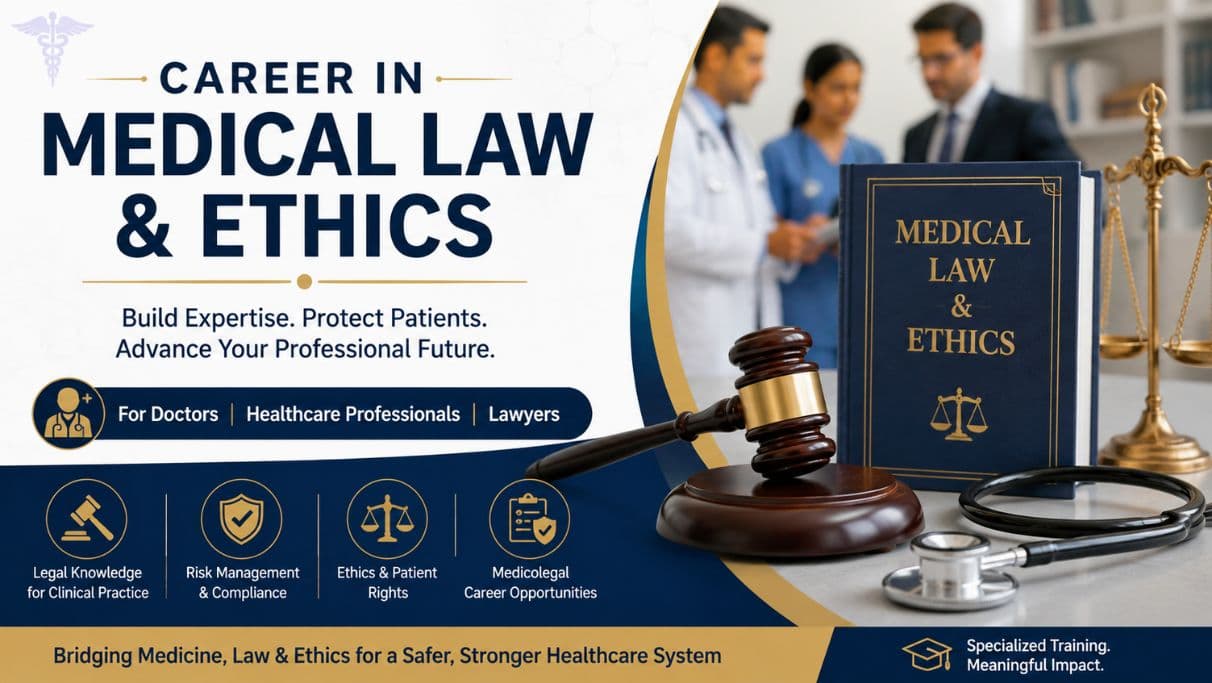
Career Scope in Medical Law and Ethics: Why Doctors Are Upskilling in Legal Training
There was a time when a medical degree alone was considered sufficient armour for a clinical career. Today, that assumption is being quietly but decisively dismantled. Across India, an increasing number of practising doctors, specialists, and healthcare administrators are choosing to supplement their clinical expertise with structured training in medical law and ethics — not as an academic exercise, but as a strategic professional investment.
A career in Medical Law and Ethics is emerging as one of the most consequential and forward-looking pathways available to doctors in India today.
Litigation against healthcare providers has risen sharply over the past decade. Regulatory frameworks governing clinical practice have grown more complex. Patients are better informed, more assertive about their rights, and more willing to pursue formal redress. In this environment, clinical competence alone no longer guarantees professional security.
A Discipline at the Intersection of Two Worlds
Medical law and ethics is not a subject taught in sufficient depth in most undergraduate or postgraduate medical curricula in India. The MBBS programme provides a broad introduction to forensic medicine and toxicology, and some exposure to medical ethics — but the depth required to navigate real-world legal disputes, regulatory obligations, or institutional compliance is rarely achieved through standard training alone.
This gap has created a significant opportunity. Professionals who invest in formal education in this discipline occupy a rare and valuable space: they understand both the clinical realities of patient care and the legal frameworks that govern it.
🔑 Key Insight: This dual fluency is increasingly sought after across a range of sectors — and it sits at the core of what makes a career in Medical Law and Ethics so compelling for practising clinicians looking to expand their professional identity and impact.
Many healthcare professionals are now pursuing a structured Master’s in Indian Medical Law and Ethics course to gain specialised legal and ethical expertise relevant to modern clinical practice.
The Scope of Medical Law in India: Why It Is Expanding
The scope of medical law in India has grown substantially in response to several converging forces:
- ›Consumer Protection Act, 2019 — brought healthcare services firmly within the ambit of consumer law, enabling patients to file complaints in consumer forums at the district, state, and national levels
- ›Clinical Establishments Act — operationalised in most states, increasing inspection, registration, and compliance obligations for healthcare facilities of all sizes
- ›National Medical Commission (2020) — replaced the Medical Council of India, introducing revised ethical guidelines and a more structured approach to professional conduct and disciplinary proceedings
- ›Digital Personal Data Protection Act, 2023 — introduced new data privacy obligations affecting electronic health records and patient information management
- ›Telemedicine and AI-assisted diagnostics — introduced entirely new legal territories that few practising doctors have been trained to navigate
✅ Key Point: The scope of medical law in India is no longer confined to consent forms and negligence suits — it now touches virtually every dimension of clinical practice and healthcare delivery.
Medical Law and Ethics Career Opportunities: Where Do Qualified Professionals Work?
For doctors who develop genuine expertise in this domain, medical law and ethics career opportunities span a wide and growing range of professional roles.
1Medicolegal Consultant
Perhaps the most direct career application, medicolegal consultants advise hospitals, clinics, and individual practitioners on matters of legal risk, documentation compliance, consent procedures, and regulatory adherence. They may also be retained as expert witnesses in legal proceedings — providing clinical opinion to courts and consumer forums on the standard of care applicable in a given case.
This is a well-remunerated and intellectually demanding role that draws directly on both clinical and legal knowledge. Many doctors strengthen their expertise here by studying medico legal consulting in India and understanding how legal advisory roles function within healthcare systems.
2Hospital Compliance Officer and Risk Manager
Large hospitals, multi-specialty chains, and healthcare networks increasingly employ dedicated compliance professionals responsible for ensuring adherence to regulatory requirements, managing legal risk, overseeing documentation standards, and leading staff training on medico-legal obligations. Doctors with legal training are particularly well-suited to this role because they understand the clinical context in which compliance requirements must be applied — not just the regulatory text.
3Healthcare Policy and Regulatory Advisory
Government bodies, health ministries, think tanks, and international health organisations require professionals who can bridge the gap between clinical knowledge and policy formulation. Doctors with expertise in medical law and ethics contribute to the design of healthcare legislation, the development of clinical practice guidelines, and the evaluation of regulatory impact — roles that carry significant influence over the broader healthcare system.
4Academic and Faculty Positions
Medical colleges, law schools, and professional training institutions are increasingly offering courses in healthcare law, bioethics, and medical jurisprudence. Qualified clinician-educators with formal training in this area can build faculty careers, design curriculum, supervise research, and contribute to the growing academic literature in a field where scholarly output remains limited relative to demand.
5Healthcare Legal Practice Support
Law firms and independent legal practitioners who specialise in healthcare litigation, regulatory disputes, and hospital advisory work routinely require clinical consultants who can help them understand the medical dimensions of cases. While this is not a primary legal role, it is a meaningful one — and it positions doctors with legal training as indispensable partners in complex healthcare disputes.
Professionals interested in dispute prevention also frequently explore medical negligence defense strategies for doctors in India to better understand litigation risks and protection mechanisms.
6Bioethics and Research Ethics Committees
Institutional Ethics Committees (IECs), which are mandatory for institutions conducting clinical research in India under ICMR guidelines and the New Drugs and Clinical Trials Rules, 2019, require members with expertise in bioethics and medical law. Participation in and leadership of these committees is a respected and increasingly professionalised avenue for doctors with formal ethical training.
Medico Legal Career for Doctors: The Skills That Matter
A medico legal career for doctors is not built on legal knowledge alone. The professionals who succeed in this space combine several distinct competencies:
- ✦Deep familiarity with Indian healthcare statutes — including the Consumer Protection Act, Clinical Establishments Act, Drugs and Cosmetics Act, NMC regulations, and evolving digital health law
- ✦Strong analytical and written communication skills — the ability to read, interpret, and produce legal and clinical documents with precision and clarity
- ✦Clinical credibility — a foundation of actual practice experience that enables meaningful engagement with clinical facts in legal or regulatory contexts
- ✦Ethical reasoning — the capacity to navigate complex situations where legal permissibility and moral obligation may not perfectly align
- ✦Continuing professional development — medical law is a living discipline; those who remain current with legislative changes, new judicial decisions, and evolving ethical standards sustain long-term credibility and relevance
Why Doctors Are Choosing to Upskill Now
The shift toward legal upskilling among Indian doctors is not a trend driven by curiosity alone. It is a response to a profession under pressure.
- ⚠Consumer complaints against doctors and hospitals have increased year on year
- ⚠Media coverage of high-profile negligence cases has raised public awareness and expectations
- ⚠The NMC’s revised ethical code has made professional conduct obligations more explicit and enforceable
- ⚠The COVID-19 pandemic brought into sharp focus the fragility of legal protections available to frontline healthcare workers
In this climate, investing in a medico legal career for doctors — whether as a full-time specialisation or as a complementary qualification that strengthens existing clinical practice — is a rational, forward-looking decision. Doctors who understand the law are less likely to face avoidable complaints, better equipped to defend themselves when disputes arise, and more capable of contributing meaningfully to the institutional and policy systems that govern healthcare delivery.
📌 Perspective: The medical law and ethics career opportunities available in India today are real, growing, and genuinely underserved by the current supply of trained professionals. For clinicians willing to invest in structured education in this domain, the timing has arguably never been better.
Start Your Medical Law Journey with MedipreneurX
MedipreneurX offers India’s most comprehensive online medical law education — designed by Dr. Arvinder Singh for practising doctors, hospital administrators, and healthcare entrepreneurs.
FREE COURSE
Introduction to Medical Law
A foundational 18-lesson course covering the basics of Indian medical law — patient rights, consent, consumer protection, and the legal framework governing medical practice. Free to enrol, no commitment required.
18+ lessons | 1+ hour of video | No cost
MASTER COURSE
Master in Indian Medical Law
The comprehensive 130-lesson programme covering medical negligence, consumer law, partnership disputes, ADR, regulatory compliance, and medico-legal documentation. Designed for practising doctors, hospital administrators, and healthcare entrepreneurs.
130+ lessons | 5+ hours of video | ₹7,899
✅ Key Takeaways
- ✓Medical law and ethics is one of the fastest-growing professional domains in Indian healthcare.
- ✓Career opportunities span medicolegal consulting, hospital compliance, policy advisory, academia, ethics committees, and legal practice support.
- ✓Dual fluency in medicine and law is rare, valuable, and increasingly in demand across public and private healthcare sectors.
- ✓Upskilling now — through structured courses like MedipreneurX’s Master in Indian Medical Law — positions doctors ahead of a profession-wide shift.
Conclusion: A Career in Medical Law and Ethics Is a Strategic Investment
A career in Medical Law and Ethics is not a departure from medicine — it is an evolution of it. The doctors who pursue this path do not leave the profession behind. They deepen their engagement with it, bringing a dimension of legal and ethical fluency that makes them more effective clinicians, more resilient professionals, and more valuable contributors to a healthcare system that is changing faster than traditional training is equipped to address.
The question for practising doctors in India today is not whether medical law and ethics matters to their career — it clearly does. The question is whether to engage with it reactively, when a dispute has already arisen, or proactively, through deliberate education and skill-building that makes such disputes far less likely and far more manageable.
Ready to Build Your Medico-Legal Career? Start with MedipreneurX.
India’s most comprehensive medical law education — taught by Dr. Arvinder Singh.
Need Personal Medico-Legal Guidance?
Book a direct consultation with Dr. Arvinder Singh — MBBS, MD, LLB, CIArb Arbitrator, IIM Gold Medalist.
Phone: +91-7073111777
Website: drarvindersingh.com
Address: 3rd Floor, 4C Arth Building, Behind Bhartiya Lok Kala Mandal, Madhuban, Udaipur, Rajasthan
Frequently Asked Questions: Career in Medical Law and Ethics
1. What is a career in medical law and ethics?
A career in medical law and ethics involves working at the intersection of healthcare, legal compliance, bioethics, hospital regulations, and medico-legal advisory services. It draws on both clinical expertise and legal knowledge to advise doctors, hospitals, and healthcare institutions on compliance, disputes, and professional conduct.
2. What are the career opportunities in medical law and ethics?
Career opportunities include medicolegal consulting, hospital compliance and risk management, healthcare policy advisory, academic and faculty roles, ethics committee participation, and legal practice support for healthcare institutions. Many of these roles are available alongside active clinical practice.
3. Why is the scope of medical law in India increasing?
The scope is expanding due to growing healthcare regulations, the Consumer Protection Act 2019, the NMC Act 2020, telemedicine, digital health compliance obligations under the DPDP Act 2023, and increasing medico-legal awareness among patients. Each of these developments creates demand for professionals who understand both medicine and law.
4. Can doctors pursue medico legal careers without leaving clinical practice?
Yes. Many doctors pursue medico legal careers alongside clinical practice by developing expertise in healthcare regulations, ethics, compliance, and legal advisory services. Online programmes like the Master in Indian Medical Law from MedipreneurX are designed specifically to accommodate working clinicians.