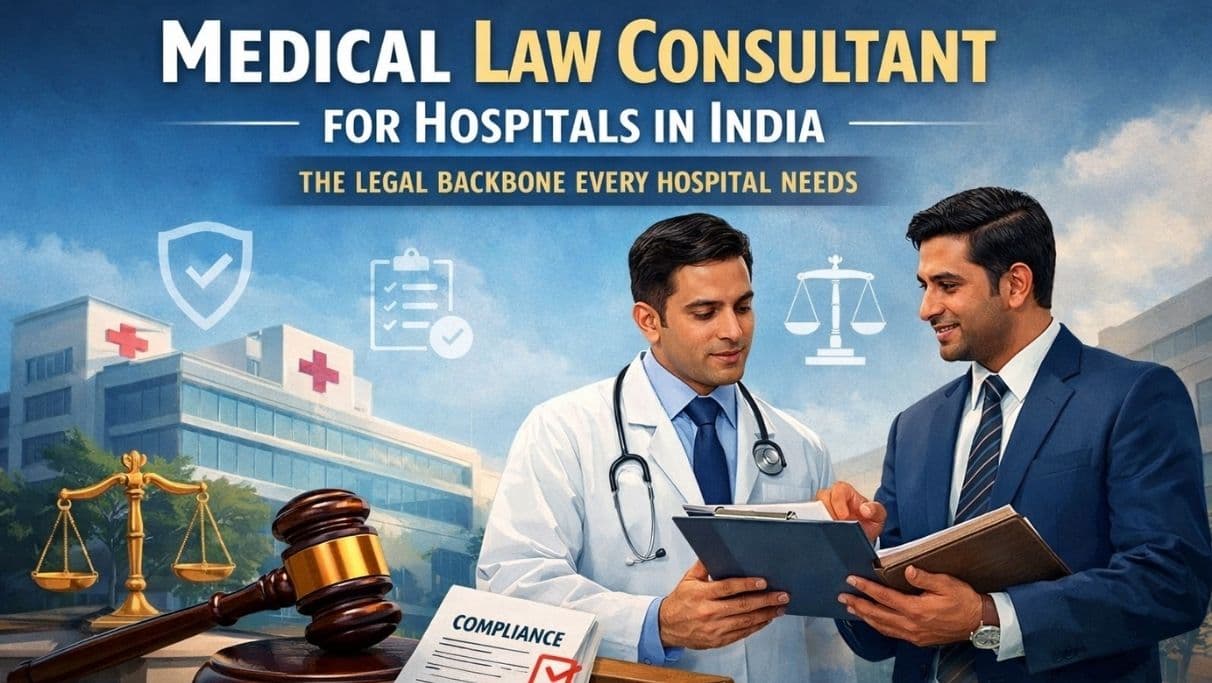
Medical Law Consultant for Hospitals in India: The Legal Backbone Every Hospital Needs
Hospitals in India operate in one of the most legally regulated environments today. While infrastructure, recruitment, and medical technology receive constant attention, the legal foundation of hospitals is often ignored until a crisis strikes. This oversight exposes hospitals to unnecessary risk, regulatory penalties, and damaging litigation that could have been avoided through structured legal oversight.
In modern healthcare, clinical excellence alone does not protect a hospital. Legal preparedness, compliance discipline, and regulatory intelligence are just as critical to institutional survival. This is why every hospital today requires a medical law consultant for hospitals in India, not merely for emergencies, but as a strategic partner in daily operations. A medical law consultant acts as a bridge between healthcare delivery and legal safety, ensuring the institution functions without regulatory disruptions.
Why Hospitals Are More Legally Exposed Than Ever
Healthcare institutions now face increasing scrutiny from government authorities, consumer courts, licensing boards, and insurance companies. Patients are well-informed and legally empowered, making disputes easier to file and harder to defend. Regulatory inspections are more frequent, and compliance standards are becoming stricter across states.
Without structured healthcare regulatory compliance in India, hospitals often remain vulnerable without even knowing it. Legal failure does not usually announce itself loudly—it builds quietly through:
- Outdated licenses
- In-complete patient documentation
- Poor consent practices
- Missing internal policies
- Weak employment contracts
- Regulatory neglect
By the time a notice or inspection arrives, the window for prevention is already closed.
A medical law expert in India helps hospitals identify these blind spots early and eliminate risks before they escalate.
The Hidden Risks in Hospital Licensing
Hospital licensing is not a one-time formality—it is an active legal obligation. Across India, hospitals must comply with requirements under:
- Clinical Establishments Act
- Biomedical Waste Management Rules
- Fire safety regulations
- Pollution control board rules
- Local health authority permissions
Legal trouble begins when renewals are missed, documentation lapses, or procedural requirements change without awareness. A Medical Law Consultant for Hospitals in India monitors regulatory shifts and ensures licenses remain valid, updated, and defensible during inspections.
Without professional supervision, licensing slowly becomes a liability instead of protection.
Compliance Failures That Trigger Legal Action
Most hospitals do not break laws intentionally. They violate them unknowingly. Compliance failures often occur due to incorrect recordkeeping, outdated operating procedures, or informal administrative practices.
Common compliance gaps include:
- Missing SOPs
- Undocumented staff training
- Weak grievance mechanisms
- Improper patient data handling
- Inconsistent clinical protocols
Individually, these look like minor issues. Legally, they are explosive.
A hospital without structured compliance invites disputes.
A hospital with legal systems absorbs them safely.
A medical law expert in India ensures these compliance gaps are filled with proper systems, protocols, and defensible documentation.
The Reality of Patient Lawsuits in India
Patient litigation is no longer rare. It is routine.
Hospitals face compensation claims not only for treatment outcomes, but also for:
-
poor communication
-
missing documentation
-
weak consent procedures
-
service dissatisfaction
-
billing disputes
-
delayed response complaints
Consumer courts increasingly treat healthcare as a service industry rather than a protected profession. That means hospitals are evaluated like service providers, and proof becomes critical.
Hospitals must understand how courts interpret deficiency in medical service under the Consumer Protection Act, because even small gaps in documentation and patient communication can become serious legal issues.
Litigation becomes expensive not because hospitals are wrong—but because they are unprepared.
Legal preparedness ensures:
-
Documentation supports decisions
-
Consent becomes defensible
-
Accountability is provable
-
Institutional protocols stand in court
Where structure exists, defense stands.
Internal Policy Failures That Destroy Hospitals from Within
Many hospital conflicts originate internally. Disputes among partners, confusion in authority, unregulated staff conduct, and unclear financial practices weaken institutions silently.
Hospitals collapse from poor governance long before lawsuits appear.
Internal legal failures usually include:
- Absence of HR policies
- Undefined authority hierarchy
- Unregulated vendor contracts
- Weak resignation protocols
- Informal profit distribution
- No audit systems
Without policy frameworks, hospitals function emotionally.
Courts function contractually.
Why Legal Audits Are More Important Than Financial Audits
Hospitals routinely conduct financial audits but rarely legal audits. This imbalance creates blind risk.
A legal audit examines:
- Regulatory compliance
- Licensing integrity
- Staff contracts
- Consent protocols
- Documentation systems
- Policy frameworks
- Litigation exposure
Financial health means nothing if legal collapse is imminent.
Law audits protect continuity.
What a Medical Law Consultant Actually Does
A medical law consultant does not wait for lawsuits. They prevent them.
They:
- Structure compliance systems
- Maintain regulatory frameworks
- Monitor legal risk
- Advise hospital boards
- Draft contracts
- Re-engineer documentation
- Prepare legal strategy
- Conduct audits
- Supervise responses
- Maintain institutional discipline
They are not involved in medicine.
They protect medicine.
A medical law consultant also ensures that hospitals are not vulnerable due to untrained staff. Because most medico-legal errors happen due to lack of awareness—not bad intention.
This is why hospitals benefit from structured medical law and ethics training for doctors, administrators, and staff.
Compliance Frameworks Are Not Optional Anymore
Hospitals today must follow structured compliance models involving documentation standards, quality controls, legal reporting, protocol consistency, and governance systems.
Legal frameworks define:
- Authority
- Accountability
- Risk control
- Crisis response
- Regulatory defence
Hospitals that build legal and ethical awareness in healthcare reduce compliance risk dramatically because their teams follow defensible systems—not informal habits.
How MediPreneurX Strengthens Hospital Legal Systems
MediPreneurX acts as a legal intelligence partner for hospitals. The focus is not litigation rescue but building legal architecture.
Hospitals are supported with:
- Regulatory compliance planning
- Governance structure design
- Policy creation and implementation
- Contract drafting
- Medico-legal audits
- Documentation improvement
- Compliance training programs
- Dspute prevention systems
As a medical law trainer in India, MediPreneurX also builds legal awareness among hospital staff, ensuring procedures are followed consistently.
The objective is operational stability through legal strength.
Hospitals rarely collapse because of clinical failure.
They collapse because of legal neglect.
Ready to Protect Your Hospital from Legal Risk?
Legal challenges in healthcare are increasing every year. If your hospital wants stronger compliance, better documentation, and complete medico-legal protection, now is the time to act.
MediPreneurX provides expert medico-legal consulting, compliance audits, policy drafting, and legal training for hospitals across India.
👉 Get Your Hospital’s Legal Audit Today
👉 Schedule a Consultation with a Medical Law Consultant for Hospitals in India
👉 Strengthen Your Compliance, Documentation & Legal Defence Systems
Contact us now to safeguard your hospital’s future.